
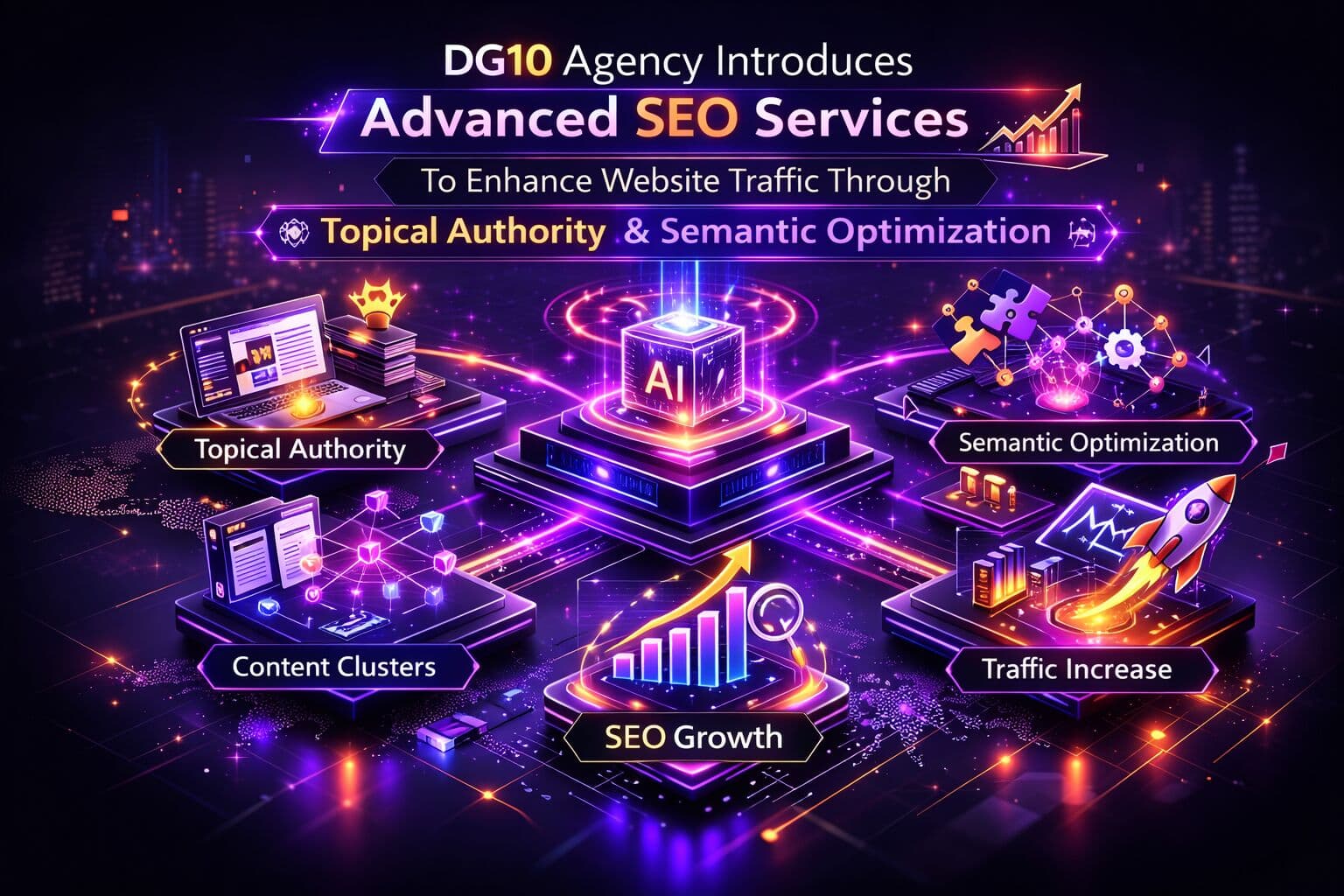
In today’s competitive search results, businesses must go beyond traditional SEO methods to stand out. Search engines like Google are prioritizing websites that demonstrate topical authority and semantic relevance over those simply targeting isolated keywords. Recognizing this shift, DG10 Agency, a leader in AI-powered web development and digital marketing, has launched a new service designed to help businesses dominate search rankings through topical authority building and semantic SEO.

Methodology note: this post describes DG10's advanced SEO service launched May 2026. Client results quoted (250% traffic, 170% page-one growth) are client-reported GA4 figures for March–May 2026, re-verified September 2026.
The Evolution of SEO: Why Traditional Keyword-Based Approaches Are No Longer Enough
SEO has dramatically changed over the years. Previously, businesses could rank higher by simply stuffing web pages with targeted keywords, but search engines have evolved to become more sophisticated. With AI-driven algorithms like Google’s BERT and MUM, search engines now understand context, user intent, and topical depth far better than ever before.
What does this mean for businesses?
Focusing on single keywords is no longer sufficient. Websites that fail to establish themselves as authoritative sources within their industry are seeing their search rankings decline. Instead, Google rewards websites that provide comprehensive coverage on specific topics and structure their content strategically. This approach is known as topical authority and semantic SEO, both of which are at the core of DG10 Agency’s latest service offering.
DG10 Agency’s Approach to Building Topical Authority & Semantic SEO
DG10 Agency’s new SEO service is built around four core pillars:
1. Topical Authority Development
Rather than targeting scattered keywords, DG10’s team helps businesses develop authority in their industry by:
✔ Creating comprehensive content clusters that interlink related pages, strengthening relevance for a given topic. ✔ Building a pillar page structure with main topics and supporting content to demonstrate expertise. ✔ Researching competitors to find content gaps and ensure full topic coverage. ✔ Enhancing internal linking strategies to improve user experience and help search engines understand relationships between topics.
2. Semantic SEO Optimization
Semantic SEO ensures that website content aligns with how people naturally search and interact with information. DG10’s semantic SEO strategy includes:
✔ Natural Language Processing (NLP) techniques to match search intent. ✔ Entity-based optimization, where Google identifies the context of words rather than just their literal meaning. ✔ Implementing schema markup and structured data to help search engines better understand content. ✔ Optimizing for voice search by adapting content to long-tail, conversational queries.
3. AI-Powered Content & Data-Driven Insights
With AI becoming a major driver of search algorithms, DG10 Agency integrates machine learning and big data analytics to optimize content strategies. This includes:
✔ AI-generated topic research to discover high-value content opportunities. ✔ Automated semantic analysis to ensure content depth and keyword variations align with user intent. ✔ Behavioral data tracking to monitor engagement and adjust content accordingly.
4. Advanced Content Structuring & Technical SEO
Technical SEO is still a critical factor in achieving sustained search visibility. DG10 ensures websites are structured properly by:
✔ Enhancing site architecture with SEO-friendly URL structures and clear navigation. ✔ Improving mobile usability and page speed optimization. ✔ Implementing Google Core Web Vitals best practices for optimal user experience. ✔ Using content tagging and hierarchical markup to help search engines categorize content accurately.
Case Study: How DG10 Helped a Tech Blog Increase Organic Traffic by 250%
To demonstrate the impact of topical authority and semantic SEO, DG10 recently worked with a technology-focused content website that struggled to gain organic visibility. Despite publishing quality content, their rankings remained stagnant.
DG10’s team:
✔ Conducted a deep competitor analysis and identified missing subtopics. ✔ Restructured their content using pillar pages and topic clusters. ✔ Implemented internal linking strategies to improve topic relevance. ✔ Introduced semantic keyword variations to match user search intent. ✔ Optimized for Google Discover and voice search.
Results: Within four months, the website saw: ✔ 250% increase in organic traffic. ✔ 170% boost in page one rankings. ✔ 65% higher engagement rates, as users spent more time on their website.
What Advanced SEO Actually Includes
When agencies say "advanced SEO," they often mean a bigger checklist of the same basics. Our definition is narrower: advanced SEO starts where plugin-driven optimization stops. It covers log-file-informed crawl budgeting, entity-based internal linking built from a topical map, schema deployed as code rather than pasted snippets, and content briefs written from SERP feature analysis instead of keyword volume alone. If a task can be done by installing a plugin and clicking through a wizard, we do not count it as advanced — and neither should you when you compare proposals.
The engagement typically opens with a technical audit that goes past Lighthouse scores into indexation economics: which sections of the site earn crawls, which waste them, and where rendering delays hide content from crawlers. From there we build a topical authority map — pillar pages supported by clusters that cover each entity completely — and wire them together with descriptive internal links. Content comes third, not first, because writing into a broken information architecture just produces well-written orphans. Finally, digital PR earns the citations and mentions that confirm authority to both Google and answer engines.
Topical Authority vs Keyword SEO: An Honest Comparison
| Dimension | Traditional keyword SEO | Topical authority + semantic SEO |
|---|---|---|
| Unit of work | One page per keyword | One cluster per entity, fully covered |
| Internal linking | Ad hoc, often exact-match | Mapped pillar-to-cluster with descriptive anchors |
| Content briefs | Built from keyword volume | Built from SERP features, entities, and questions asked |
| Technical focus | Meta tags and sitemaps | Crawl budget, rendering, schema as code |
| Measurement | Rankings for head terms | Share of voice across the topic + assisted conversions |
| Durability | Decays with each algorithm update | Compounds — coverage gets harder for rivals to replicate |
The table explains why the tech-blog case study below moved 250% in four months: the site did not just publish more, it closed topical gaps competitors had left open for years. Keyword SEO would have chased the same head terms everyone bids on; authority work captured the long tail nobody had mapped.
How We Measure Advanced SEO Results
Rankings are reported, but they are not the scoreboard. For every engagement we track four numbers weekly: organic sessions to cluster pages (is coverage earning visits?), share of voice across the mapped topic (are we taking the subject, not just keywords?), crawl stats from Search Console (is Google spending budget on the right sections?), and assisted conversions from organic (does the traffic do anything?). When all four move together, growth survives updates; when only rankings move, we treat it as borrowed.
Cadence matters as much as metrics. Technical fixes ship in the first 30 days, the topical map lands by week six, and content clusters publish two to four pieces weekly after that. Most clients see leading indicators (crawl behavior, impressions on long-tail) in 60 to 90 days and revenue indicators in months four to six — which matches the four-month window in our case study. Anyone promising page-one rankings in 30 days is selling traditional SEO with an "advanced" label.
What Advanced SEO Costs in 2026
Pricing is where comparison shopping usually collapses, because quotes describe different work in identical language. As of September 2026, a genuine advanced engagement — audit, topical map, schema implementation, and ongoing cluster production — runs $2,500 to $8,000 per month for SMBs and $10,000+ for enterprise sites above 10,000 pages, based on the proposals we both send and compete against. One-time technical audits with log-file analysis sit between $3,000 and $12,000 depending on site size. If a quote comes in far below these bands, check whether it includes the topical map and schema-as-code work or just rebadged basics.
Structure the commercial terms around the measurement plan above. We tie monthly reporting to the four numbers — cluster sessions, share of voice, crawl stats, assisted conversions — and set explicit 90-day leading-indicator targets before anyone talks about revenue. Fixed-fee audits, monthly retainers for cluster production, and quarterly strategy reviews is the combination that has survived contact with real clients; pure performance pricing sounds attractive but misaligns incentives toward head-term chasing. Ask any vendor, including us, to show a redacted report before you sign — the shape of the reporting tells you what they actually optimize.
Red Flags When Buying Advanced SEO
Three warning signs separate genuine authority work from relabeled basics. First, the proposal has no topical map deliverable — just "content" and "links" line items. Without a map, there is no coverage strategy, only output. Second, reporting leads with keyword rankings and never mentions crawl stats or share of voice; that vendor optimizes what is easy to show, not what compounds. Third, timelines promise page one in 30 to 60 days for competitive terms — authority does not compound that fast, so the promise reveals either inexperience or churn-and-burn tactics. Walk away from any two of the three, and always ask for that redacted sample report.
Why Businesses Need to Act Now
The SEO ground is shifting fast, and businesses that fail to adapt to Google’s preference for authoritative, contextually relevant content risk falling behind.
Key benefits of implementing DG10’s topical authority & semantic SEO strategy:
✔ Higher search rankings & visibility ✔ Increased organic traffic & user engagement ✔ More brand credibility & trust ✔ Improved lead generation & conversions ✔ Long-term SEO sustainability
Keep Reading on DG10
- Best AI Keyword Research Tools (Tested & Compared)
- Perplexity SEO: AI Citation Guide
- Core Web Vitals Fix: Developer Guide to Lighthouse 95
Limited-Time Offer for New Clients
To help businesses gain a competitive edge, DG10 Agency is offering a special introductory package for a limited time. New clients can access premium SEO services at an exclusive rate starting at Rs. 10,999.
How to Get Started with DG10 Agency
Businesses interested in transforming their search rankings and website traffic through advanced topical authority and semantic SEO can reach out to DG10 for a free consultation.
📍 Visit: https://pages.dg10.agency/build-topical-authority-implement-semantic-seo/
📧 Email:[email protected]
📞 Call: +91 9311153543